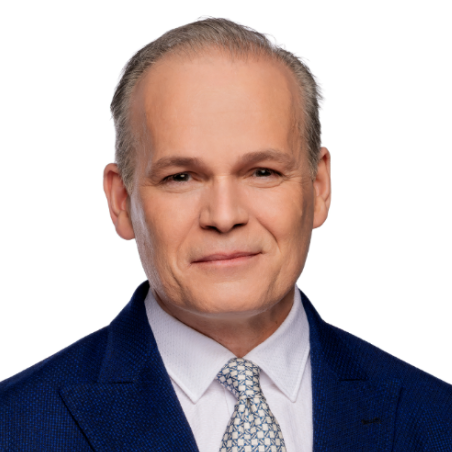
Graham Richardson
Ottawa Bureau Chief
Bachelor of Journalism, 1993
The news business is where I'm meant to be.
“The news business is where I’m meant to be,” says Graham Richardson, BJ’93, recalling why he returned to CTV and the Ottawa News Bureau as the Ottawa Bureau Chief for CTV National News after spending 18 months as the Managing Director Media and Communication for the consultancy firm Edelman. Prior to his departure from media, Richardson had been anchoring CTV Ottawa for more than 14 years.
In his career as a reporter for CTV Toronto, a parliamentary correspondent for CTV National News and a reporter for CBC Calgary, Richardson has seen it all. He’s covered the Afghanistan War, Hurricane Katrina, the Michael Jackson trial, the 2006 Winter Olympics Games in Torino and dozens more monumental slices of our history.
Working at CTV again felt like “coming home to a family,” says Richardson. “We all feel so connected to each other here.”
Here, Richardson discusses why the pull of journalism was too strong to resist, how King’s professors influenced him and what advice he would give to political journalists today.
You were a parliamentary correspondent for CTV in 2006. What are the most important changes you’ve seen in how journalists report from Ottawa in the past 20 years?
I think the volume of output has completely changed in our industry. We’re all doing everything virtually every day. People are not gathering around the television watching the news conventionally.
You’re going to see breaking news on your phone, on social media, hours before you watch the 6 p.m. news broadcast. What’s changed, then, is that viewers are still turning to these broadcasts for trusted, reliable voices and for deeper analysis.
You took a break from journalism. What led to your decision to leave CTV, and what drew you back?
At one point, I asked myself, “Am I going to anchor the news until I’m 65?” I’d just turned 54, and I realized the answer was no. I’ve done what I had to do there.
In a government relations town, a public affairs communications job is the obvious thing to do. But I didn’t do that kind of work for Edelman; instead, I was more of their director of media and communications, and I conducted some media training and crisis communications sessions, too. It was a nice refresh.
What drew me back? Well, my most fulfilling years as a reporter were literally in this CTV Ottawa office working with Bob Fife when I was a correspondent, and he was the Bureau Chief. So, when I got a call to talk about me becoming Bureau Chief and having a leading editorial role, well, let me put it this way: If I had said no, I wouldn’t have forgiven myself.
I talked to former anchor Kevin Newman about what I should do, I remember. He said to do what feels right. So, I did.
Turning to King’s, did any classes or professors influence your career or teach you something that has stuck with you all these years?
[Political science professor] Nelson Wiseman and Margaret Daly, who was my broadcast professor, stand out to me. Margaret is blunt and has a truth-to-power ethos that she honed for many years at the CBC.
I remember once I was talking to Wiseman about what I wanted to specialize in, maybe print, maybe broadcast, I really didn’t know what to do. He looked at me and said, ‘You’re going to do TV.’ I guess he just knew.
What advice would you have for political journalists working in Canada today?
Read it all and watch it all. And I mean full newscasts, not just tiny clips on TikTok. If you’re covering City Hall or a legislature, you have to meet people in person, and while texting and emailing will obviously happen, political reporting needs on-the-ground reporting. After all, these politicians are here to have face-to-face contact with the media, and journalists have to not just report on what is happening but also make it make sense to Canadians.