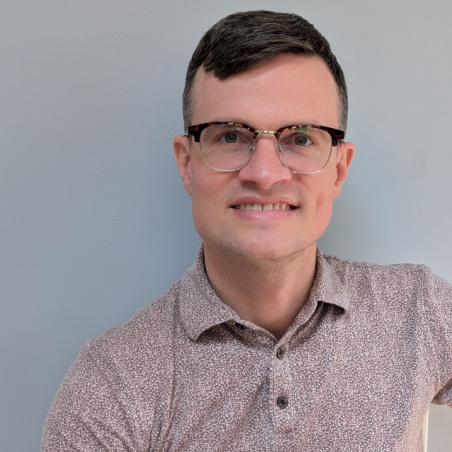
Thomas Bailey
Vice President, Operations
Bachelor of Science, 2007
I remember learning how to be open to different opinions and why it’s critical to not just accumulate knowledge for the sake of it, but to better learn how to synthesize it.
Every day, Thomas Bailey, BSc’07, influences the future of food. As the Vice President of Operations at n!Biomachines, part of The Cultivated B, his company manages a range of bioprocessing technologies that turn microorganisms into sustainable proteins and ingredients. Based in Burlington, Ont., Bailey’s work may soon be found in the vegan burgers you buy or the prescription drugs you pick up.
Think of n!Biomachines as the backbone behind companies that, primarily, make alternative proteins in grocery, cosmetic and nutritional items. If the non-meat burgers in the neighbourhood grocery are made from beans, mushrooms or tofu, they may one day be enhanced with biomanufactured proteins.
“We’re trying to reduce the environmental impact of traditional protein products,” Bailey says in an interview, referencing how ecologically harmful the traditional animal protein business has become in the past 30 years.
After all, Bailey points out, you don’t need an entire pig to leverage its protein value. “If you can grow that same protein in a plant or bacteria with less electricity, less land use, that’s inherently going to be a win,” he says.
Long before Bailey was deep in the complex field of turning cells into factories, he worked in China to apply what he was taught at King’s: how to be open to new ideas, stay curious and critically assess new knowledge.
Soon after you graduated from King’s, you began working in Taiwan and China. What drew you there?
First, I went to Taiwan to teach English, and that was a real eye-opening experience. I ended up working in Taiwan, where I met my wife. We enjoyed living in Asia and decided to stay and pursue our careers. After graduating from National Cheng Kung University in Taiwan, I really wanted to work in Beijing. China was gaining a lot of momentum in technology, which has always appealed to me.
While working for a trade NGO, the Canada China Business Council, I was exposed to large Canadian companies which got me interested in working with bigger corporations, and I was also able to network with Canadian officials.
This is where my time at King’s was great for me. I remember learning how to be open to different opinions and why it’s critical to not just accumulate knowledge for the sake of it, but to better learn how to synthesize it. That’s a lesson that comes up with my work at n!Biomachines, too.
How does your company create alternative proteins that aren’t only associated with food, but drugs and vaccines, as well?
We act behind-the-scenes providing tech to companies that currently work with animal products but want to change for cost, ethical or branding reasons. We want to help them do that.
Our technology works like a fancy blender for growing different kinds of cells: bacteria, yeast, fungi or plant cells. Companies can program those cells to create a variety of useful materials, like tiny factories. These machines can be small and sit on a bench or scale up to thousands of litres in a batch. These systems provide precise control of temperature, mixing speed, pH and other factors needed for cell growth.
What’s been really interesting to learn, as I got into this area, is how many ingredients can be biomanufactured and included in so many products we buy, such as cosmetics and pharmaceutical drugs, and even in vaccines.
Can you share a specific example of who uses your bioprocessing machines?
There’s a canned-goods manufacturer and they have a lot of food waste. They toss it or pay to have it removed. But we worked with them on a project where they’re using bacteria that consumes the waste, meaning less is sent to the landfill. In addition, this bacterium excretes an acid after it consumes food waste. That acid is a common ingredient in other foods, so we’re turning a waste product into something that companies can use.
Do you take a side on the ethical views on whether companies should use animal meat to make their products?
We’re not wading into ethical debates as we’re more of a mission-based business. So, we’re focused on making proteins in the most efficient way possible, and what comes out of that is the value of being sustainable. That’s what a lot of companies want and what consumers are looking for in the companies they buy from.