Giancarlo Cininni and Antonia Zwissler take a slow and steady approach to doomsday shelter story
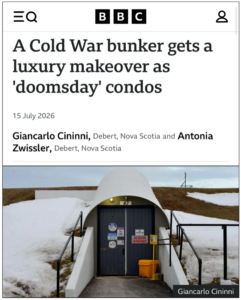 When news broke that a Cold War bunker in Debert, N.S., was being converted into a luxury nuclear fallout shelter, national news outlets reported it and moved on. Giancarlo Cininni, BJ(Hons)’24, and Antonia Zwissler, BJ(Hons)’25, stuck with it for months, and their feature, A Cold War bunker gets a luxury makeover as ‘doomsday’ condos, was published by the BBC in July.
The two freelancers decided to pursue the story because there “wasn’t enough background” in the published versions, Cininni said in an interview.
“They didn’t interview the owner of the bunker,” he added. “They didn’t interview people who live in the community. I thought that there was more to the story, especially getting that deeper local perspective.”
As freelancers, Cininni and Zwissler had one resource many other news reporters didn’t—time. Over the next few months, they travelled to Debert to see the bunker and interview locals. With persistent phone calls, they snagged an interview with Jonathan Baha’i, the owner of the bunker.
“Other people had to pitch and get a deadline, but we wrote our whole piece and then pitched,” said Zwissler. “We had several months of saying, ‘well we can just wait longer.’ And I think, honestly, having that luxury of waiting is what mainly helped us.”
That luxury comes from working freelance. Neither Zwissler nor Cininni jumped into reporting full-time after graduating from King’s.
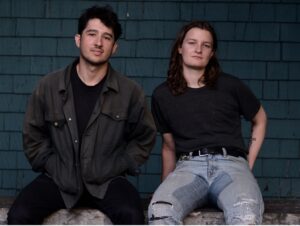 Giancarlo Cininni (left) and Antonia Zwissler (right) say they are comfortable playing the long game when it comes to their stories, and even their journalism careers (Photo by Lewis Morin)
“When I did my internship, I was like, oh my God, I can’t do news. I’m so scared,” said Zwissler. After doing their internship at a publishing house, Zwissler started writing for Grand Parade, a small Halifax paper. “I’m really impressed by some of my classmates who jumped right into doing CBC casual or something. But I’m always going to be more about taking it a little slower.”
Cininni had a job as a shelter worker at Out of the Cold, a non-profit providing low-barrier support to unhoused individuals in Nova Scotia. When Out of the Cold closed, he was laid off. The lay off came with employment insurance and time.
“I thought, well, I can write now. I can spend a bunch of time focusing on the craft while I look for work,” said Cininni.
Seaside meeting
When you hear that Zwissler and Cininni graduated from King’s journalism school only a year apart, it’s easy to assume that’s where their partnership started. But it actually started out on the ocean—the pair started as surfing buddies before realizing they were both journalists.
“It was kind of like a band,” said Cininni. “When [Zwissler] was like, do you want to write articles together? I was like, yeah, let’s start a journalism band.”
“We’re all going to need each other a lot more. It comes down to not seeing your peers as competitors but as potential teammates.”
When working together, Cininni shoots the photos and does the driving, while Zwissler has the grammar and the editing eye. They share everything else—researching, interviewing and writing.
“It’s a lot of haggling,” said Cininni. “It’s not like there’s a lead or a front person. We, you know, kill our darlings.”
Cininni and Zwissler agree that their collaboration (and their haggling) is what made the piece a success.
“You hear that journalism is a very competitive field and that people don’t collaborate, but I would say do the opposite,” said Cininni. “We’re all going to need each other a lot more. It comes down to not seeing your peers as competitors but as potential teammates.”
Only around a third of their first draft made it into the BBC piece, Zwissler said, but this isn’t the end of their bunker journey. The Halifax Examiner picked up another of their pitches, and that story is scheduled for publication in the fall of 2026.
Originally published in the King’s Journalism Newsletter, Volume 1, Issue 4