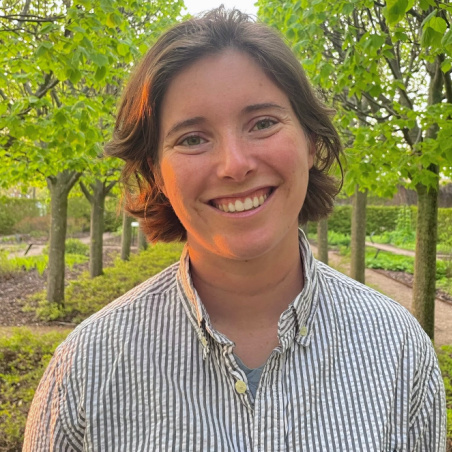
Catherine Evans
Senior Data Analyst
Bachelor of Science, 2019
I love talking to people and getting into the weeds to learn their story and how can we work together to solve a problem. I feel really lucky to be able to do that...
After just 10 minutes of talking to Catherine Evans, BSc’19, it’s clear her passion for science and environmental stewardship has fueled her inspiring career.
As a Senior Data Analyst at DeepSense, an innovation hub at Dalhousie that pairs industry partners with academic experts, she primarily works in the natural resources and oceans systems sector and finds deep satisfaction in helping answer key questions, such as, in her words, “does this data we have help us learn something or create a new product?”
That question might revolve around, say, coastal erosion or how certain underwater vegetation can remain healthy, or tracking behaviour of algae blooms.
Impacting the path from exploration to execution, Evans interests began as a high school student growing up in Sackville, N.B. “I’ve always loved a good science project, so it’s fun to walk into a new project and say, ‘Let’s see what works.’”
Her most recent work has been compiled into two forthcoming study papers. She spearheaded an analysis that tracks shoreline erosion over time, and the other study investigates how fishing practices affect protected marine areas.
Here, Evans unpacks what she finds fulfilling about her marine science career and her inspiration for founding an innovative new company.
A lot of your work focuses on using satellite imagery to track what’s going on in our coastal environments, our protected areas. What do you find intriguing about that kind of data?
I’ve always been really passionate about studying satellite imagery. It’s about understanding what kind of changes you can track as different satellites tell you different things. I enjoy looking at how we can model what might be going on under the ocean’s surface with satellite pictures of the surface.
I look back at my time at King’s as being very formative for me. I enjoyed learning about structural geology, understanding how everything fits together, and the story behind all of that. With satellite imagery, it’s the same thing in the sense that we see a change happening and we look at how it happened and how we can track that data. Also, how can we predict what might happen next?
I’m also very passionate about climate change and seeing if I can help create tools that assist communities to be able to adapt to disasters or prevent them.
Can you share an example of some of these projects?
Recently we looked at tracking behaviour of algae blooms in Darlings Lake in New Brunswick. This lake only started having blooms around 2021, and we spent 18 months talking with monitoring groups there that received funds to track the blooms more frequently. We looked at certain trends, such as how a drought encouraged these blooms to spread all the way across the lake, and then how another year had a lot of flooding, pushing those blooms to more coastal regions.
Our team was working with a monitoring group to figure out how they should prioritize their funds and field work.
You also recently launched a start-up called Advanced Climate Monitoring that focuses on similar projects that you do at DeepSense. Why did you decide to become an entrepreneur?
My co-founder and I have joked about how we wear a lot of different hats at any one time, and how we’re switching one hat for another when we take on different projects to offer different solutions.
We got a lot of great feedback from people about what I’ve done at DeepSense, and how it’s important to bring together academics, researchers and journalists to take on issues related to climate change and climate monitoring. I’m very into using smart technology to help communities with climate change, and that’s what we will be doing at Advanced Climate Monitoring.
I also love talking to people and getting into the weeds to learn their story and how can we work together to solve a problem. I feel really lucky to be able to do that in my career.
What do you hope to accomplish with this newly incorporated company?
The first step is finding the right scientific tools to give to communities—tools they both understand and contribute to.
The second step is ensuring people trust the digital tools that could be available to them. With the emergence of AI, there is a lot of talk about ethical AI and using it responsibly from an environmental perspective—making sure it doesn’t use up too much power to find the right solutions, for example, and we’ll contribute to that conversation.
We want to help communities make the tools that will help them in the future.
By David Silverberg
Published March 2026
Through our Ask an Alum program, we can connect you with alumni who can answer questions and provide advice to assist you in your career path.