“There’s just so much support and such a sense of community that continues after the program ends…”
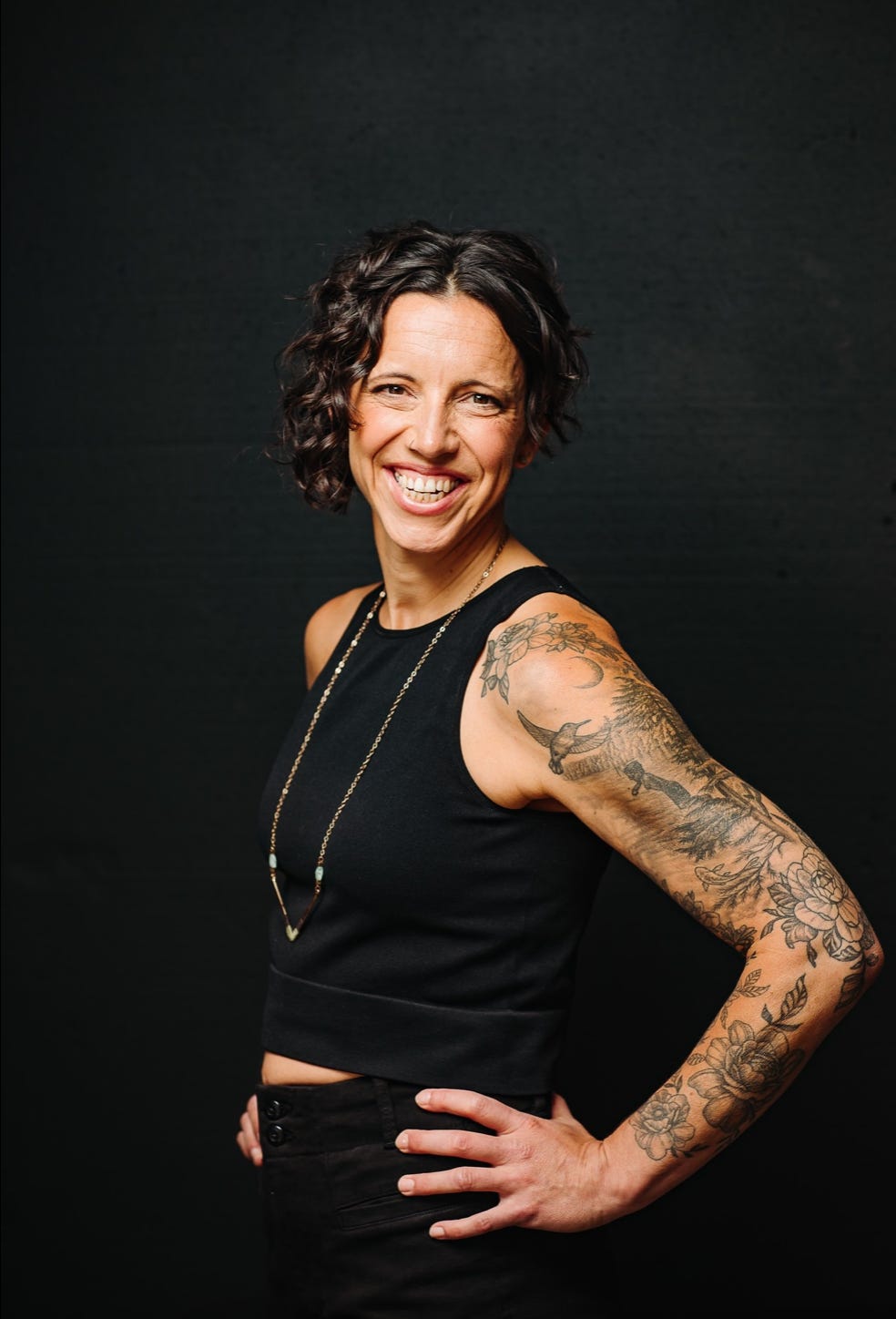 When psychiatrist and professor Joanna Cheek, MFA’24, applied to the Master of Fine Arts in Creative Nonfiction program, a question had been circulating in her mind for years: What if peoples’ mental health conditions weren’t a sign of weakness, but a normal reaction to a world that’s both literally and figuratively on fire?
“I actually found that I was noticing system problems that were bigger than what I could address in my office,” says Cheek, who teaches and practices psychiatry at the University of British Columbia’s School of Medicine. “I felt like a lot of self-help books were missing social context.”
So, taking a hint from the oft-quoted words of author Toni Morrison, “If there’s a book that you want to read, but it hasn’t been written yet, then you must write it.” Cheek set out to do just that.
Her book, It’s Not You, It’s the World: A Mental Health Survival Guide For All, released by HarperCollins in February, provides resources for strengthening our mental health, while acknowledging what she calls the “ailing systems”—social, economic, geopolitical, environmental—that are often catalysts for mental health concerns.
“I wrote it in hopes of decreasing the stigma that’s misplaced onto individuals,” she says about the book. “If we just individualize and treat, we’re trying to get rid of the distress. But that’s not the actual problem. My book’s really saying that we can’t just be healthy by only trying to feel better in a sick world.”
Once we learn how to be more resilient, we can begin making changes to those systems that keep us in a cycle of feeling depressed, anxious or hopeless, the book argues. That argument was shaped and polished during Cheek’s time in the MFA program.
Heading into the program, Cheek, who had previously completed a 10-month journalism program at the University of Toronto, had the advantage of a clear and comprehensive book idea. As a freelance health journalist, she was starting to gain a reputation as an expert on the interconnectedness of mental health and larger social crises, with bylines in the Toronto Star, CBC and the Conversation. But her nonfiction classes at King’s helped refine the book’s title, framing and ultimately, what she wanted readers to take away from it. “The program helped me make it sexy, and it really worked,” she says. “I think they really helped me frame it in a way that agents, publishers and general audiences could understand.” Cheek worked with mentors Kelly Thompson, who specializes in writing and speaking about trauma, and Cooper Lee Bombardier, who she felt was savvy about incorporating a diversity, equity and inclusion lens into his writing. “It was just the perfect combo,” says Cheek. “My book does really write about lived experiences and other peoples’ experiences, and I wanted to be able to do that without appropriating or harming the people that I’m highlighting.”
For Cheek, the program wasn’t only about honing her longform craft skills, but also about making connections, both personal and professional. She met her agent, Transatlantic’s Marilyn Biderman, during one of the program’s winter residencies. When her manuscript proposal was finished, she sent it to Biderman who agreed to represent her, and soon after, landed a two-book deal with HarperCollins. “It was quite the whirlwind. But without the program, I would have never been in the right room,” says Cheek.
While workshopping manuscript chapters, Cheek also came to appreciate the breadth of professional experience her fellow students brought to the program, with many having worked in the mental health field or having lived experience of trauma themselves. In part, she attributes this to the vast age range the program attracts, including plenty of students in middle-age and beyond. “The wealth of experience and lived experience in particular was so helpful,” she says. “I felt really lucky to come [to the program] at this later-in-life time.”
Much of Cheek’s last few months have involved launch events and speaking engagements for It’s Not You, It’s the World. But as she looks ahead to her second book under contract with HarperCollins—about the societal benefits of neurodiversity—she still relies on the relationships made in the program, both for emotional support and for practical suggestions.
“There’s just so much support and such a sense of community that continues after the program ends that I’m so lucky to have.”
This story was published in the latest edition of the MFA Scribbler, edited by Adelle Purdham, MFA’22.
The MFA Scribbler shares news about, from and for students, staff, alumni and friends of the University of King’s College Writing & Publishing Program. Read the Spring 2026 Newsletter.