Through coaching two of Canada’s national goalball teams, King’s Athletics Director brings important insights back to the Quad
 King’s Athletics Director Matthew Bartley has had a busy year. Besides beginning his new role at King’s in August 2025, Bartley is deeply involved in Nova Scotia’s goalball community as the Head Coach of Canada’s Youth National Team and the Assistant Coach of the Men’s National Team.
Goalball is a Paralympic sport, played by athletes who are blind or visually impaired. It is a unique sport because it does not have an able-bodied equivalent. The game is played on a gym floor, volleyball court dimensions, with nets at each end stretching nine-metres long, and requires a 1.25-kilogram ball with two bells inside to help orient the players. All players wear eyeshades to ensure a level playing field. The goal of the game is to throw the ball, often using a bowling motion, into the opponent’s net while the opposing team tries to block it with their bodies. Each team consists of six players, with three on the court at a time.
In early November, Bartley accompanied Canada’s Youth National Goalball Team to the Youth Parapan American Games in Chile. The team fought hard and won the bronze medal in a close 10-9 game against Mexico.
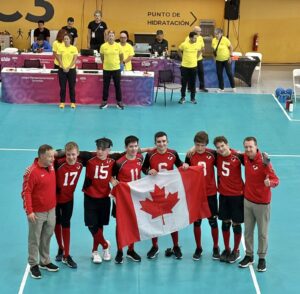 Bartley has been involved in the goalball world for some time. Thirteen years ago, he saw a poster on the Dalhousie campus for a volunteer position as a goalball judge. From there, he became a certified referee and then started coaching Team NS.
“The athleticism caught my attention right off the bat,” said Bartley. “It was a new-to-me game, and my curiosity for sports, that’s what drew me to it originally. I just said I have to be a part of this community.”
Bartley did not play the sport as an athlete before becoming a national team coach and said he is trying to fill this gap by participating as an athlete during weekly practices.
“Once you put the eye shades on, it feels like a different world,” said Bartley. “You use skills and you think in a way that you don’t in other sports.”
Bartley’s dedication to the sport has not gone unnoticed by his team. Harry Nickerson, who scored the winning goal against Mexico at the Youth Parapan American Games and is also the youngest player to ever compete on the men’s national team, says working with Bartley has been “incredible.”
“Matt’s been a very good coach. He adapted so well, really came to learn the game very, very quickly, and now I don’t like going to tournaments without him.”
“Once you put the eye shades on, it feels like a different world,” said Bartley. “You use skills and you think in a way that you don’t in other sports.”
Peter Parsons also competes on the men’s national team and is the chair of Blind Sports Nova Scotia. He says having a university athletics director involved in the sport could create “a lot of opportunities for partnership” and “get the word out more about goalball.”
Bartley said that his involvement in goalball has given him a greater appreciation for the ways community creates better athletes.
“The whole goalball environment is about community,” said Bartley. “That’s from the coaches to the high-performance director, to the players, to the many volunteers. Everyone is buying into the same purpose. That is what we hope to do at the university level, really nourish that community aspect.”
Bartley’s emphasis on building a community through sport for athletes was evident in his memories from Chile. He said his favourite part of the competition was learning more about who the athletes were off the court during team meals, and seeing their confidence grow on an international stage.
“Strong community comes through building safety, sharing vulnerability and establishing purpose. Through this process comes the wins, comes the success, comes the relationships that last much longer than your time spent on the court,” said Bartley. “With goalball itself, I have been fortunate enough to sit in team circle debriefs and hear raw thoughts from our players. Sports offers athletes a place to belong, a place to feel significant, a place to be with others living life with similar obstacles. The power of a small cohesive group cannot be underestimated. I try to bring those insights back to UKC to help enhance the quality and delivery of our own programs.”
When asked how else these experiences have shaped him, he says that attending major games has been incredibly valuable to his work as an Athletic Director. “These experiences allow me to better understand what high-performance environments require and how small details can elevate the athlete journey.”
He’ll have more of these opportunities on the horizon: The Youth National Team is awaiting a final decision on host location for their World Championships; while the Men’s National Team is now focusing their efforts towards preparing for the 2026 World Championship in China.