This year’s keynote speaker offered alternative ways to view depictions of the Black commentator in historical Western art
On January 30, the 14th-annual Conference of the Early Modern kicked off with a keynote lecture from Dr. Angela Vanhaelen on “The Secrets of The Black Commentator.”
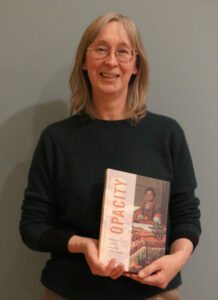
Dr. Vanhaelen is a professor of art history at McGill University who has written several books about art and culture in the 17th-century Dutch Republic and its colonial empire. Her lecture at King’s explored the subject of her most recent book, Opacity: Blackness and the Art of the Dutch Republic, published by Penn State University Press as the inaugural volume of their book series AFRICANAS. This series invites scholars from a range of disciplines to explore African and African-diasporic histories, lived experiences and futures.
In Opacity, Dr. Vanhaelen reframes the conversation around Dutch art from the 17th century that included Black figures, often to signal slavery and servitude. Depictions of Black people became more common in Netherlandish art as Dutch merchants became drivers of the transatlantic slavery business during a time of European expansion and the Atlantic slave trade’s forced integration of Black people into Europe.
As the European trade routes expanded, so too did the presence of enslaved African people in the private lives of wealthy Europeans. This is reflected in the increase in Black figures in European domestic art, often using an artistic device referred to as “the Black commentator,” a recurring, often marginalized figure who gazes back at the viewer, bridging the artwork’s narrative and the audience.
In her work, Dr. Vanhaelen explores different depictions of the Black commentator, ranging from the Three Magi to 17th-century Dutch portraits and domestic scenes. She traces the use of the Black commentator to 15th-century Italian artist Leon Battista Alberti, who used these characters to “tell the spectator what is going on,” to “beckon” them to look into that world, or to “challenge them not to come here as if he wished their business to be secret.”
Much of Dr. Vanhaelen’s lecture focused on secrecy. Specifically, “public secrecy,” which is increasingly relevant in today’s political climate, as it was during the time of the active slave trade. It’s this veil of public secrecy which allowed the slave trade to flourish in the Netherlands, despite the practice being declared illegal on Dutch soil.
“Public secrecy shields the practices of people who wield political and economic influence,” said Dr. Vanhaelen. “It protects the powerful by publicizing what can and cannot be said about the operations of power and politics and also disallowing oppositional perspectives.”
“The art of knowing what not to know, and seeing what not to see, is a fundamental form of social knowledge.” Dr. Vanhaelen added that this concept is often left out of how we interpret paintings.
These paintings, intended as a pictorial record of domestic prosperity, serve as a form of public record to the enslavement of non-European labourers, often children, who had been trafficked by the Dutch West India Company, and sold into slavery. Through the incorporation of the enslaved child into domestic portraiture, the complicity of the public in the atrocities is revealed.
“Abuse has persisted because people turn a blind eye. The presence of enslaved people in Dutch cities was generally known but not publicized or addressed by people who saw what not to see,” said Dr. Vanhaelen. “Public secrecy was taught as a means of bringing the general public into collective complicity with the structuring of power, privilege and profit.”
The room of interested students and professors was captivated as Dr. Vanhaelen spoke. Dr. Simon Kow, the Director of the Early Modern Studies Program, described the lecture as “excellent and illuminating.”
“Research on how marginalized and oppressed people were depicted in early modern art is a growing and fascinating area of study,” said Kow. “Traditionally, the ‘Golden Age’ of the Dutch 17th century is celebrated for the beautiful art, think Rembrandt, Vermeer and others, and prosperity of the times. But only now are people in the Netherlands and beyond coming to terms with how the Dutch trading empire depended on and absorbed marginalized and oppressed people of African descent.”
Assistant Professor of Humanities Dr. Justina Spencer recommended Dr. Vanhaelen as a keynote lecturer for the EMSS Conference. “There is a consistent and growing interest in art and visual culture at King’s,” said Spencer. “We thought a keynote by an art historian would be of interest to the student body.”
Spencer’s intuition appeared to be correct, as many students stayed behind to speak with Dr. Vanhaelen at the event’s reception.
Dr. Vanhaelen also referenced another subject in Western art that often depicts Black subjects as internal viewers within a painting: nativity scenes that feature the Three Magi bringing gifts to Mary and baby Jesus. This trope depicting Black figures bestowing gifts of wealth on a white religious figure, Dr. Vanhaelen says, speaks to European desires to display Europe as the centre of religion and economic power.
She shared 15th– and 16th-century depictions of the Three Wise Men that have been described as “lacking a well-defined gaze,” or as having “a dumbstruck, dull or glazed look.” But by adjusting your perspective, that melancholy expression often associated with Black figures can “appear dignified,” and a glazed look can “convey traits like seriousness, contemplation or defiance.”
With this in mind, Dr. Vanhaelen said that her research aims to open possibilities for looking differently at paintings that “attempt to draw viewers into complicity.”