The Master of Journalism student earned the award for investigating the roots of residential school denialism and highlighting Indigenous resilience through on-the-ground reporting in Kamloops, B.C.
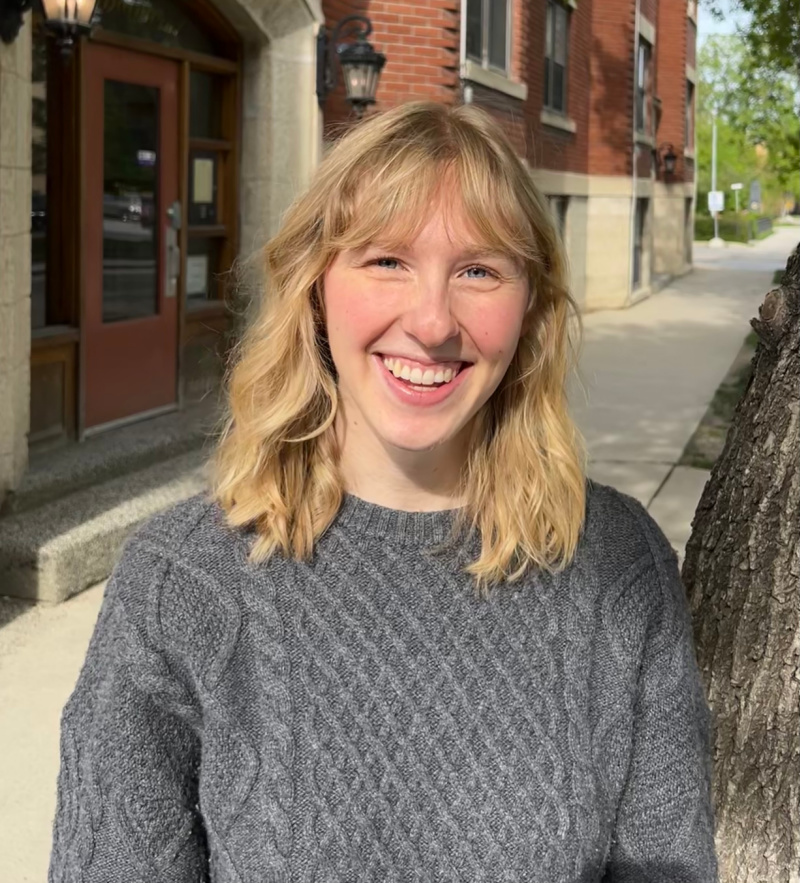 When Emily Enns began exploring a story about the replacement of existing Canadian street names with Indigenous ones for her second-year Master of Journalism (MJ) investigative journalism project, she did not expect it to lead her into one of the nation’s more contentious historical debates.
While researching, she came across an online rant opposing street-name changes in Winnipeg. What surprised her was not the content but that it was written by a professor at her alma mater, the University of Manitoba (UM). Curious, she began looking more closely at the professor’s work, which led her to writings that downplayed the impact of the residential school system.
Enns soon discovered that some of the most visible disseminators of residential school denialism were not fringe commentators but academics, whose views were being platformed by registered Canadian charities. “Both of those things caught my attention as something worth looking into,” she says.
She ultimately shifted the focus of her MJ project to investigate the motivations behind residential school denialism. Enns says her interest in the story stems from her studies of history at UM, including a course on the residential school system. Denialists are becoming more vocal these days, she observes. One of the scholars she interviewed sees denialism, now surfacing in demonstrations on campuses out West and across social media platforms, as another iteration of “the myriad ways that settler colonialism plays out.”
The project, which also examines Indigenous resilience and resurgence in the face of denialism, has earned Enns this year’s Peter Mansbridge Investigative Writing Award. The gift of esteemed Canadian journalist Peter Mansbridge, this award was created in 2024 to encourage the best in emerging journalistic talent. Valued at $4,000 annually, the award is presented to a second-year student pursuing a Master of Journalism or Master of Fine Arts in Creative Nonfiction to assist with costs of travel and research for a project that exemplifies excellence in investigative research and writing.
“The award gives the two sides of the School of Journalism, Writing & Publishing a chance to get together and discuss the incredible work being done by both our MFA and Journalism students, highlighting how committed they are in bringing true stories to a Canadian readership,” says Dr. Gillian Turnbull, Director of Writing & Publishing. “Emily’s project is a bold one that ambitiously seeks to uncover a story core to our national narrative. Her plan for investigating the charities and individuals involved will advance investigative reporting at King’s in important ways.”
Entering the program with no prior journalism background, Enns says the MJ program has shaped nearly every aspect of her reporting. She describes the King’s faculty as consistently supportive, singling out Associate Professor David Swick as particularly influential. “A lot of his tips are living in my mind these days while I’m writing.”
The power of immersive journalism
Designed to support investigative projects that seek to prompt change or build awareness, the Mansbridge Award enabled Enns to travel to the Tk̓emlúps te Secwépemc First Nation reserve in Kamloops, B.C. In 2021, the First Nation shared that preliminary findings of a penetrating radar survey found approximately 200 potential unmarked graves, thought to contain the remains of Indigenous children, on the grounds of the former Kamloops Indian Residential School.
“Everyone I spoke to gave me a knowing look when I said I was writing about residential school denialism,” says Enns, who visited local cultural spaces and connected with community members during her stay in Kamloops. “Many have feared for their own safety because of this wave of worsening denialism. The survivors I’ve spoken to on the phone have talked about the horrors of their school experience, the impacts on their entire families and the exhaustion from having to deal with people denying their experiences again and again.”
Enns also visited the former residential school. “It’s chilling, walking the grounds after hearing some of the stories from people who attended, but the [Tk̓emlúps te Secwépemc First] Nation has repurposed the buildings for its own use. There’s a strong sense of community and culture,” she says.
“Being able to experience the content you’re writing about makes all the difference in the quality of the research and the writing,” she adds. Without being there, the article “would have been missing a significant, more visceral element.”
Associate Professor of Journalism Lisa Taylor, who worked with Enns on her project in its early stage and provided final sign-off, says this kind of on-the-ground reporting is essential. “For students, both for the richness of the experience and for the content they produce, there’s just no substitute for showing up and being there,” she says. Enns is not Indigenous, and by doing what Taylor calls “slowing down, taking time, showing up,” her reporting reflects the importance of the Truth and Reconciliation Commission of Canada Call to Action 86. This call asks Canadian journalism programs to require education for all students on the history of Aboriginal peoples, including the history and legacy of residential schools. We need to produce journalism that fits the community, instead of “asking the community to fit a kind of colonial approach to journalism,” says Taylor.
To date, Enns has conducted more than 20 interviews. By incorporating the perspectives of residential school survivors and their descendants, she is able to present the talking points of denialists without reinforcing them. “It’s a tricky thing to navigate—people who are writing things I know have caused harm and that they feel are personal to them,” she says. She spoke with one person who had worked as a residential school supervisor, while another had attended as a white student because his father was the principal.
Taylor says Enns’ project demonstrates the depth that investigative reporting can bring to complex issues. “This story gets past the headlines and the kind of 500-word daily stories about this to help people really understand where it comes from, who is disseminating it and what the implications are.”
The King’s MJ program aims to graduate leaders in the field. It is built around a nine-month professional project. Students dive deeply into a single topic, doing extensive research, interviews and data analysis. They are supported by a team of King’s faculty and industry professionals.
“Emily’s project exemplifies the kind of deeply researched, impactful journalism that MJs undertake over those nine months,” said Fred Vallance-Jones, Director of Journalism and one of the three award judges along with Turnbull and investigative author Jessica McDiarmid, BJ(Hons)’08, MFA’16.
The judges noted “the quality of Enns’s writing, planning and thinking, the strength of the research already completed, the importance of the story and the courage it takes to pursue a project of this magnitude and depth.”
Banner Photo by Donna McL on Unsplash